
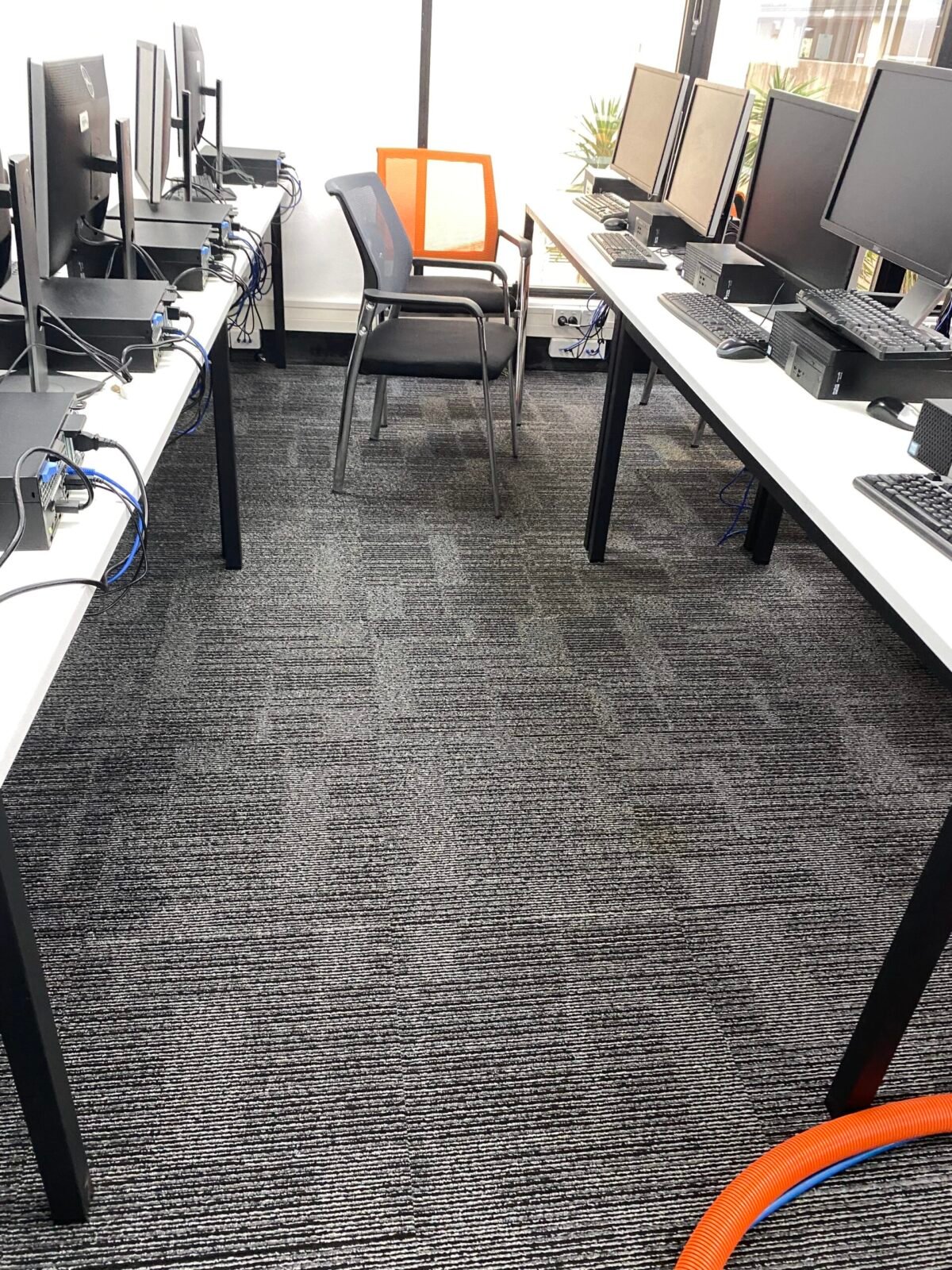
Businesses across Australia spend a combined several billion dollars annually on commercial cleaning services. Understanding why to hire professional cleaning services goes well beyond keeping a workspace tidy. The expenditure is driven by compliance obligations, insurance requirements, staff health outcomes, and the measurable financial consequences of failing to clean to a professional standard.
The sections below work through each driver in detail. They also cover the honest cost comparison between in-house and outsourced professional cleaning services, what commercial cleaning costs in Australian capital cities, which industries carry specific regulatory cleaning requirements, and what to ask any operator you are considering engaging.
What Commercial Cleaning Actually Is?
Commercial cleaning is a professional service category that covers the systematic cleaning, sanitising, and maintenance of business premises. It covers offices, medical centres, schools, childcare facilities, warehouses, retail stores, strata common areas, and industrial sites. The scope, chemistry, and equipment involved are fundamentally different from domestic cleaning because the environments being cleaned carry different contamination loads, regulatory obligations, and occupancy densities.
A commercial cleaning company operates under a service contract that defines frequency, scope, access times, and accountability standards. The company is responsible for supplying its own trained staff, commercial-grade equipment, and industry-appropriate cleaning products. The business owner or facilities manager does not manage cleaners directly. That management responsibility sits with the cleaning company.
This distinction matters more than most business owners realise. When you manage an in-house cleaner, you carry the employer obligations: recruitment, payroll, superannuation, WorkCover insurance, training, supervision, and cover during leave or illness. When you engage a professional cleaning company, those obligations transfer. You pay a service fee and receive a defined outcome. The legal and operational burden sits with the contractor, not with you.
Benefits of Hiring Commercial Cleaning Services
Businesses hire commercial cleaning services to maintain a clean, safe, and professional environment for employees and customers. It helps improve hygiene, meet compliance standards, and support smooth daily operations.
1. The WHS Obligation Most Business Owners Underestimate
Under the Work Health and Safety Act 2011, businesses in Australia must ensure their workplace is safe and without health risks, which includes maintaining proper cleanliness. This goes beyond appearance, as Safe Work Australia requires clean restrooms, hygienic kitchens, safe floors, and proper ventilation. Failing to maintain these standards can lead to workplace injuries, health issues, and legal liability for business owners.
Many businesses underestimate how far these obligations extend, assuming compliance only applies to equipment and hazardous materials. In reality, cleaning is a key part of workplace safety. Professional commercial cleaning services provide documented records of cleaning activities, helping businesses demonstrate compliance, something that is often missing with in-house cleaning approaches.
2. Indoor Air Quality and Its Effect on Productivity
Office air is constantly circulated through HVAC systems, meaning everything in the environment such as dust, allergens, fibres, and microbial particles is continuously redistributed. Research from Safe Work Australia and the Australian Institute of Occupational Hygienists shows that poor indoor air quality can lead to headaches, fatigue, irritation, and reduced concentration, which are common issues in many office environments.
The link between air quality and cleaning is direct. Contaminants from carpets, desks, and ventilation systems all contribute to what employees breathe. Regular professional cleaning, including HEPA vacuuming, surface disinfection, and carpet treatment, reduces airborne particles and improves indoor conditions. This is where commercial cleaning adds real value by supporting better health and productivity through cleaner air, not just cleaner surfaces.
3. Absenteeism and the Cost of Illness Spreading Through a Workplace
Workplace illnesses spread primarily through airborne transmission and surface contact, with high-touch areas like door handles, shared devices, and kitchen surfaces acting as contamination points. Viruses such as rhinovirus, influenza, and norovirus can survive on surfaces for hours or even weeks, increasing the risk of infection if proper cleaning is not maintained.
Basic cleaning may reduce visible dirt, but it does not eliminate harmful pathogens. Effective disinfection requires the right products, correct dilution, and proper contact time. Professional commercial cleaning ensures high-risk surfaces are properly disinfected, helping reduce the spread of illness and minimising disruptions caused by employee sick leave and lost productivity.
4. First Impressions in a Commercial Context
Every visitor forms an immediate judgment about a business based on what they see. Dust, worn carpets, or unclean bathrooms signal a lack of attention to detail, and that perception often extends to the quality of the service itself, whether it is a law firm, medical practice, or office environment.
On the other hand, a clean and well maintained space builds trust and communicates professionalism without saying a word. For industries like food service, childcare, and healthcare, cleanliness is also a regulatory requirement, and visible cleaning issues can lead to compliance actions during inspections.
5. The Asset Protection Argument
Commercial spaces contain high value assets like carpets, flooring, and fittings, and their lifespan is directly affected by how they are cleaned and maintained. Dirt and grit trapped in carpet fibres or on hard surfaces act as abrasives, causing wear and damage over time if not properly removed through regular professional cleaning.
Consistent maintenance using the right equipment and methods helps extend the life of these materials, reducing the need for costly replacements. Whether it is carpet, timber, vinyl, or polished concrete, professional cleaning protects your investment and delivers long term cost savings.
In-House Cleaning Versus a Professional Commercial Cleaning Company
When a business employs its own cleaner, the cost includes wages at or above the Cleaning Services Award 2020 rate, superannuation at 11.5%, WorkCover insurance, equipment purchase and maintenance, cleaning product supply and storage, training, and the management time required to supervise, roster, and cover leave. None of these costs appears in the payslip figure.
A business owner who says “our cleaner costs us $28 an hour” is usually describing the base hourly rate. The actual loaded cost, when all on-costs are included, is substantially higher.
A professional cleaning company absorbs all of those costs within its service fee. The business pays for the outcome, not the inputs. When the commercial cleaner is sick, the company sends a replacement. The business owner does not manage that. When the equipment fails, the company replaces it. The business owner does not manage that either.
|
Cost Factor
|
In-House Cleaner
|
Commercial Cleaning Company
|
|---|---|---|
|
Base wages
|
Employer pays
|
Included in service fee
|
|
Superannuation (11.5%)
|
Employer pays
|
Included in service fee
|
|
WorkCover insurance
|
Employer pays
|
Included in service fee
|
|
Equipment purchase
|
Employer pays
|
Included in service fee
|
|
Equipment maintenance
|
Employer pays
|
Included in service fee
|
|
Cleaning product supply
|
Employer pays
|
Included in service fee
|
|
Training
|
Employer provides
|
Included in service fee
|
|
Leave cover
|
Employer must arrange
|
Company responsibility
|
|
Public liability insurance
|
Employer holds
|
Company holds
|
|
Quality oversight
|
Employer manages
|
Company responsibility
|
For most Australian businesses, the in-house option becomes genuinely cheaper only when the premises are very large, require full-time daily cleaning, and the business has the management infrastructure to run a cleaning team. For small and medium businesses, the loaded cost comparison generally favours outsourcing.
What Commercial Cleaning Actually Costs in Australia?
Pricing for commercial cleaning services in Australia is influenced by several variables. No honest guide can give a single figure because the range is wide. What is useful is understanding what drives the number.
- Premises size and layout are the primary factors. A 200 square metre office suite and a 2,000 square metre warehouse require fundamentally different inputs of time, labour, and equipment. Most commercial cleaning companies price per square metre for a given service scope, or price per visit based on a quoted duration.
- Cleaning frequency affects both the per-visit price and the total monthly spend. Daily cleaning contracts are typically priced at a lower per-visit rate than weekly contracts because the premises do not accumulate the same level of contamination between visits. A premises cleaned five days a week requires less intensive work per visit than the same premises cleaned once a week.
- Service scope determines which tasks are included. A standard commercial cleaning scope typically covers hard floor mopping and vacuuming, bathroom sanitising and restocking consumables, kitchen bench and sink cleaning, rubbish removal, and dusting of accessible surfaces. Specialist services, including carpet hot-water extraction, window cleaning, high-pressure washing, upholstery cleaning, and deep sanitisation, are usually priced separately or scheduled periodically outside the regular service scope.
- Industry-specific compliance requirements add cost for settings where standard cleaning is not sufficient. A medical practice requiring hospital-grade disinfectants applied to defined zones under documented infection control protocols costs more to clean than an equivalent-sized accountancy office, because the input costs and skill level required are higher.
- Location affects labour cost because award rates are uniform nationally, but cost-of-living and labour market conditions vary. Cleaning services in metropolitan Sydney and Melbourne typically cost more than equivalent services in regional centres.
As a rough guide, standard office cleaning in Australian capital cities ranges from $35 to $60 per hour for general services. This figure should be treated as a starting point for comparison, not a fixed benchmark, because the scope and output standard behind hourly rates vary significantly between providers.
The right question is not “how much does it cost” but “what do I get for this cost, and what happens when the standard is not met.” A written service agreement that defines scope, frequency, quality standards, and remediation process is what separates a professional commercial cleaning relationship from one that deteriorates after the first month.
Industries Where Professional Commercial Cleaning Carries Regulatory Weight
For most businesses, the choice to hire a commercial cleaning company is operational. For certain industries in Australia, it carries regulatory compliance implications that cannot be side-stepped.
- Medical and dental practices in Australia operate under state and territory health facility standards that include infection prevention and control requirements. The Therapeutic Goods Act 1989 and state-based legislation impose obligations around sterile field maintenance and surface disinfection in clinical areas. Cleaning in these environments requires documented infection-control protocols, defined zoning to prevent cross-contamination, and specific product selection to meet required kill claims against relevant pathogens.
- Childcare and early learning centres in Australia are regulated under the Education and Care Services National Law and its associated Regulations, which require services to take reasonable steps to ensure premises are kept clean, hygienic, and in good repair. Cleaning products used in those environments must be non-toxic and appropriate for use around children. Documentation of cleaning schedules and product safety data sheets is expected during regulatory visits.
- Food businesses operating under the Food Standards Australia New Zealand Code are required to maintain food premises in a clean and sanitary condition. The concept of clean in this context has a specific regulatory meaning: free from food residues, dirt, and other contamination visible to the naked eye under normal lighting, and sanitised to a level that does not present a food safety risk. Failure to meet this standard during a local council inspection can result in notices, penalties, and, in serious cases, closure of the business.
- Commercial tenants have obligations under most standard commercial leases to maintain the premises in a clean and tidy condition throughout the tenancy and to return the premises in a clean state at the end of the lease. A professional cleaning record is evidence of compliance if there is a dispute with a landlord over the end-of-lease condition.
The Hidden Cost of Not Hiring a Commercial Cleaning Company
The cost of not cleaning professionally does not appear on any line item. It emerges gradually and in forms that are not obviously connected to cleaning standards.
An employee who develops chronic rhinitis because the office is dusty and the HVAC filters are never cleaned does not write “poor cleaning” on their sick leave form. They write “illness.” The cost of that lost time is attributed to HR, not to facilities.
A client who decides not to continue a professional relationship because the meeting room felt grimy and the bathroom smelled does not write feedback that says “your cleaning is poor.” They simply do not return. The lost revenue is attributed to sales, not to facilities.
A carpet that needs replacement three years earlier than it should because it was never properly maintained creates a capital expenditure that is attributed to building costs, not to cleaning savings.
These costs are real. They are just not visible in a way that makes the cleaning budget an obvious target for comparison.
The opinion here, formed from the weight of the operational evidence, treating commercial cleaning as a discretionary cost to be minimised, is the wrong frame. It is a facilities management function with direct connections to compliance, staff performance, asset longevity, and client-facing reputation. Minimising it does not remove those connections. It just shifts the cost downstream, where it is harder to see and more expensive to address.
Summing Up
The real reasons for hiring commercial cleaning services are not about aesthetics. They sit in WHS compliance records, sick leave figures, asset replacement costs, and the legal obligations that transfer away from you the moment you engage a professional operator rather than manage cleaning yourself.
Every business running its own cleaning arrangement is carrying a cost that does not appear on a single line item. That cost is real. Comparing it honestly against a professional service fee usually produces a different answer than most business owners expect.
Work With Spotzi Commercial Cleaning
If you are based in Australia and looking for a commercial cleaning service that takes compliance, consistency, and communication seriously, Spotzi Commercial Cleaning is worth a conversation.
Spotzi provides professional commercial cleaning services for offices, retail premises, medical facilities, schools, and strata properties. Every quote is based on a site assessment, not a generic price list. Service agreements are clear on scope, frequency, products used, and what happens when something is not right.
What to expect when you contact Spotzi:
- A site assessment at no cost or obligation.
- A written quote that details exactly what is included.
- Confirmation of public liability insurance and workers’ compensation coverage.
- A named point of contact, not a call centre.
- Get a Free Site Assessment from Spotzi Commercial Cleaning
Or call us directly at +61409948888 to speak with someone who can answer your questions about your specific premises and cleaning requirements.
Frequently Asked Questions
What is the difference between commercial cleaning and domestic cleaning?
Commercial cleaning is performed in business premises by trained staff using commercial-grade equipment and industry-appropriate products, under a service contract that defines scope and accountability. Domestic cleaning is performed in residential settings with general-purpose products and without the compliance documentation, insurance structure, or industry-specific protocols that commercial settings require.
How often should commercial premises be professionally cleaned?
The appropriate frequency depends on the premises type, foot traffic volume, and industry-specific requirements. A standard office with moderate foot traffic is typically cleaned three to five times per week. A medical practice or food preparation area may require daily cleaning with periodic deep sanitisation. A warehouse or low-traffic storage facility may be adequately maintained with less frequent visits. The cleaning company should assess the premises before recommending a schedule, not offer a generic frequency.
What is included in a standard commercial cleaning contract?
A standard scope typically includes vacuuming and mopping of floor surfaces, sanitising of bathrooms and restocking of consumables, wiping down of kitchen and break room areas, removal of rubbish, and dusting of accessible surfaces. Specialist services, including carpet extraction, window cleaning, pressure washing, and deep sanitisation, are usually scoped and priced separately as periodic additions to the regular service.
Is a commercial cleaning company responsible if something is damaged during a clean?
A reputable commercial cleaning company carries public liability insurance that covers damage to the client’s property caused by the cleaning company’s staff. The service agreement should specify the insurance coverage level and the process for raising damage claims. Engaging a company without adequate insurance transfers that risk to the business owner. This is one reason why the insurance question should be asked before signing any contract.
What should a commercial cleaning contract include?
At minimum, a professional service agreement should define: the specific scope of services included, the cleaning frequency and scheduled times, the products to be used and where product substitutions require client approval, the quality standard against which the service is measured, the process for raising service issues and the expected response time, and the insurance coverage held by the cleaning company. A contract that is vague on any of these points creates conditions for disputes that are difficult to resolve.
Can a commercial cleaning company clean after hours to avoid disrupting the business?
Yes, and this is standard practice for most professional operators. After-hours cleaning removes the disruption of cleaning activity during business hours and allows cleaners to access the full premises, including workstations and meeting rooms that are occupied during the day. Most service agreements allow the business owner to specify access requirements, including preferred entry times, alarm procedures, and key management protocols.
What is the difference between disinfecting and sanitising?
Sanitising reduces microbial contamination on a surface to a safe level but does not eliminate all microorganisms. Disinfecting uses a product with a proven kill claim to destroy or irreversibly inactivate specific micro-organisms to a defined standard. Sterilising eliminates all micro-organisms, including spores, and is relevant in surgical settings rather than standard commercial environments. For most business premises, sanitising of general surfaces and disinfecting of high-touch and high-risk surfaces is the appropriate combination.