
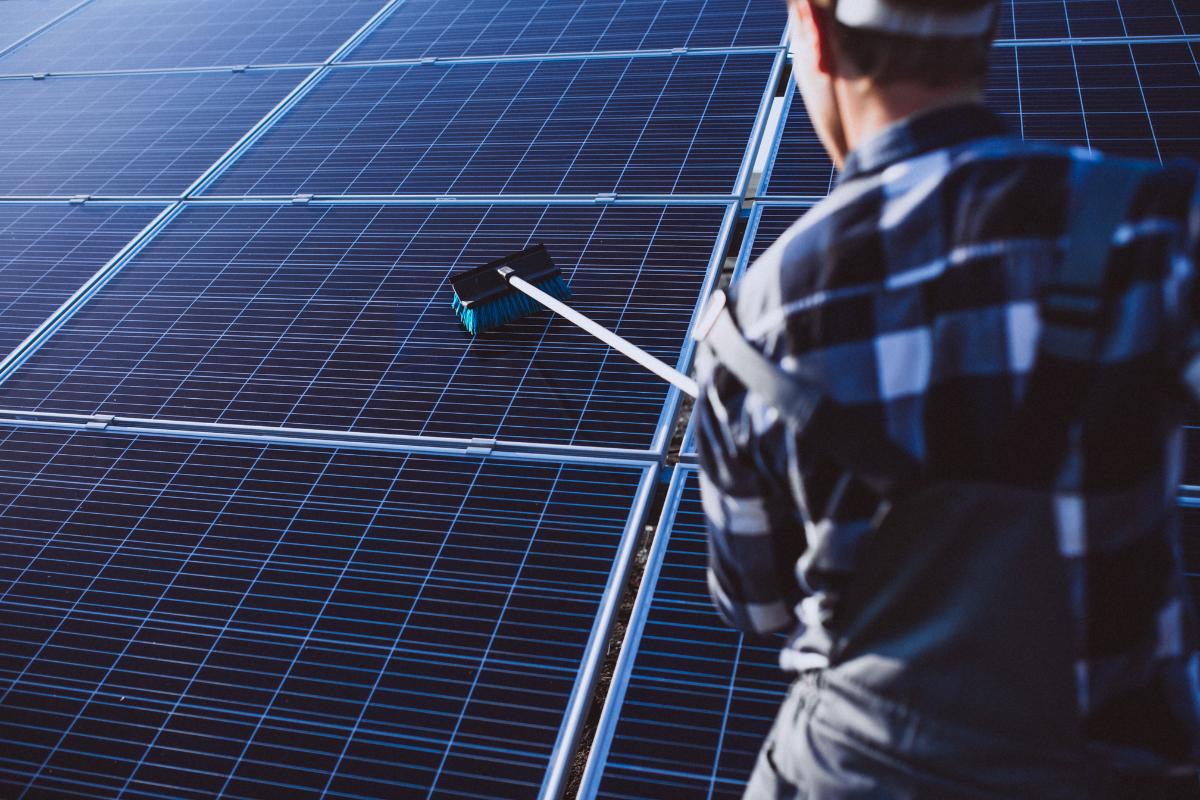
Commercial solar panel cleaning removes accumulated surface contamination from photovoltaic modules to restore the volume of irradiance reaching the solar cells. Contaminants such as industrial dust, marine salt aerosol, and acidic bird droppings settle on the module glass and steadily increase the system soiling ratio.
This physical barrier restricts light transmission and lowers the direct current electricity produced by the array. Because inverter output remains entirely proportional to the irradiance the panels receive, unmanaged surface soiling creates a measurable loss in daily electrical yield and financial return for the operating site. Professional panel cleaning, therefore, operates as a critical asset maintenance procedure rather than a basic facility housekeeping task.
What Is Commercial Solar Panel Cleaning and Why It Is Not the Same as Hosing Panels Down?
Commercial solar panel cleaning is the scheduled removal of accumulated surface deposits from photovoltaic modules. It functions as a financial maintenance discipline rather than a cosmetic exercise. While a solar cell possesses a fixed conversion efficiency, its real-world output changes entirely based on the irradiance reaching the glass surface. Any surface soiling limits this irradiance and proportionally reduces the electrical yield and commercial return of the system.
Rainfall provides a rinsing agent for loose particulates on angled mounts, but it cannot dissolve adhesive contaminants like bird droppings, mineral deposits, or industrial fallout. Lifting these requires professional physical agitation and precise water chemistry that protects the sensitive antireflective coating bonded to the glass.
Understanding commercial cleaning requires mapping the relationships between the primary physical assets:
- A photovoltaic panel contains silicon cells beneath a tempered glass sheet and a bonded antireflective coating. This coating maximises photon capture but remains highly vulnerable to abrasive contact and standard chemical cleaning products.
- The inverter converts direct current into usable alternating current. Because the inverter output directly tracks the irradiance reaching the panels, this output data acts as an accurate proxy measurement for the surface condition of the array.
- The mounting system establishes the panel tilt angle. Flat installations accumulate pooled water that evaporates into concentrated mineral residue, while angled mounts allow partial rainwater rinsing but still retain strongly bonded contaminants.
- Soiling describes all surface contamination. It generates a soiling ratio (the proportion of rated output lost to obstruction) and a soiling rate (the accumulation speed dictated by the specific installation environment).
Ultimately, professional cleaning acts directly on the panel surface to restore the antireflective coating function, elevate the irradiance reaching the silicon cells, increase the inverter electrical yield, and drive the system soiling ratio back toward zero.
Why Commercial Sites Lose More to Soiling Than Residential Systems?
System scale determines why surface contamination damages commercial sites exponentially more than residential installations. While a 6 to 10 kilowatt residential system experiences negligible monthly losses to moderate soiling, a commercial site operating a 100 kilowatt array compounds that identical deficit daily.
Sustaining a 15% soiling ratio on a 400-kilowatt-hour daily production target at $0.20 per unit subtracts over $4,000 annually from site revenue. Energy management systems consistently obscure this cost, categorising the daily reduction as an environmental variable rather than a reportable equipment fault.
Commercial sites additionally encounter aggressive contaminant profiles invisible to residential rooftops. Industrial zones generate particulate fallout, while coastal locations deposit salt aerosol that attacks the glass electrochemically. Agricultural regions are exposed to fertiliser and pesticide drift. Construction activity creates silica dust that bonds tightly under high temperatures, and traffic corridors blanket panels directly with exhaust particulates and tyre wear compounds.
Because each contaminant profile possesses a distinct soiling rate, adhesion mechanism, and precise removal requirement, generic cleaning invariably fails. A provider deploying identical water chemistry and physical contact for both a coastal solar farm and a suburban warehouse roof is merely executing a superficial surface rinse with commercial-grade equipment.
The Soiling Types That Affect Commercial Solar Systems
Understanding what is on the panels is the precondition for knowing how to remove it without causing damage.
- Bird droppings represent the most immediately damaging soiling type. Their complete opacity creates a concentrated shadow over individual cells, while their highly acidic chemistry (reaching pH values below 4.0) rapidly dissolves the antireflective coating. Localised heat building beneath this coverage forces bypass diodes to divert current around the blocked cell, generating a hot spot that permanently reduces the rated output of the module and shortens its lifespan by years.
- Coastal salt aerosol continuously deposits sodium chloride and marine salts onto coastal arrays. These crystalline structures adhere aggressively to glass and resist moderate rain. Without scheduled physical cleaning, accumulated salt permanently etches both the antireflective coating and the photovoltaic glass surface, converting a temporary soiling deficit into a permanent efficiency loss.
- Industrial and traffic fallout contains fine, highly adhesive carbonaceous particles, heavy metal compounds, and silica from construction sites and road surfaces. This widely dispersed material drives the steady soiling accumulation that monitoring systems consistently misattribute to normal seasonal irradiance variation.
- Agricultural spray residue coats rural commercial installations with nitrogen-rich compounds from fertiliser drift. Warm conditions force this film to partially polymerise directly onto the panel glass, rendering standard rinsing completely useless without applied physical agitation and specific cleaning chemistry.
- Moss, lichen, and algae aggressively colonise panel frames across locations holding persistent moisture. This biological growth retains water against the module, accelerates frame metal corrosion, and ultimately destroys the critical frame adhesive seal. Safe removal demands a photovoltaic-rated biodegradable biocide applied before mechanical cleaning.
- Leaf and pollen deposits produce severe seasonal production drops. Spring pollen lays down a uniform restrictive film, while accumulated leaf debris creates localised shading events that basic monitoring systems read identically as internal module faults.
What Commercial Solar Panel Cleaning Equipment Actually Does?
Equipment choice in commercial solar cleaning is not cosmetic. It is the variable that determines whether the cleaning restores output or causes damage.
1. Pure Water Technology
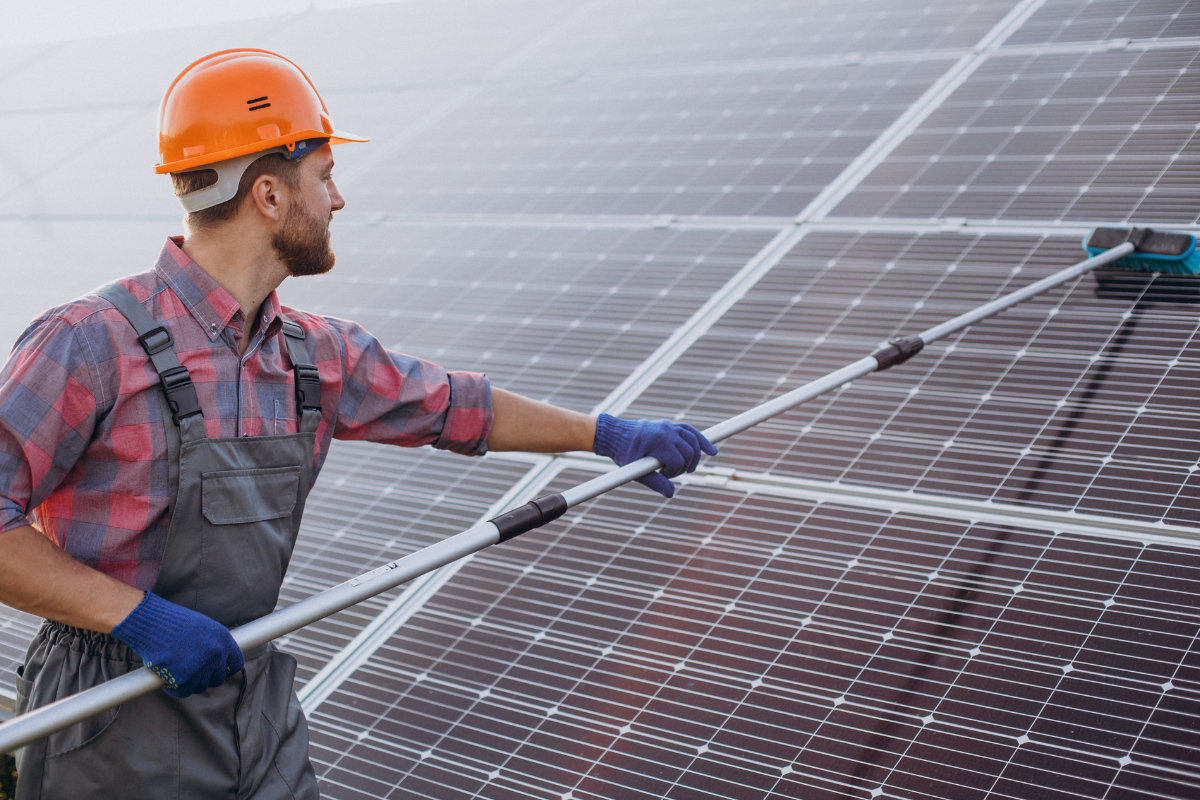
The industry standard method for commercial solar panel cleaning in Australia is the delivery of deionised or reverse-osmosis-filtered water through a soft-bristle brush system. Tap water contains dissolved calcium, magnesium, chlorine, and other minerals at concentrations that vary by location. When tap water evaporates from a glass surface, it deposits those minerals as white spotting. Over repeated cleaning events with mineralised water, the deposit builds into a translucent film that reduces light transmission in the same way that any surface contamination does.
Purified water with a total dissolved solids (TDS) count at or near zero leaves no deposit when it evaporates. It also behaves differently at the surface level. Deionised water is chemically aggressive in the sense that it actively seeks to absorb ions from whatever it contacts. On a soiled panel surface, it draws mineral particulates and salt deposits off the glass surface rather than allowing them to re-deposit as the water evaporates.
The relationship between water purity and cleaning outcome is direct: higher water purity produces a cleaner panel surface and a longer interval before re-soiling.
2. Rotary Soft-Bristle Brush Systems
For large commercial arrays, automated rotary brush systems are a workable solution. A motorised brush head with soft nylon or microfibre bristles rotates at a controlled speed across the panel surface while purified water is delivered continuously through the brush head. The mechanical action lifts bonded contamination without the point pressure that would risk cracking the glass or scoring the anti-reflective coating. The system covers panels at a consistent speed and with consistent contact pressure, delivering a reproducible result across every module in the array.
This reproducibility is important in a commercial context. A cleaning result that varies from panel to panel creates inconsistent baseline data for monitoring systems trying to distinguish soiling from equipment faults.
3. Solar Cleaning Robots
Robot cleaning systems are now deployed by specialist providers across Australia for large solar farm applications. These autonomous or remotely operated units travel along panel rows, applying purified water and brush contact at manufacturer-specified pressures. They operate at times that optimise cleaning chemistry early morning when panels are cool, and dew is present, or at programmed intervals during low-irradiance periods. Robots reduce labour cost at scale and eliminate the safety risks associated with human access to elevated or extensive ground-mounted arrays.
The value of a robot system is not speed alone. It is the consistency of contact pressure, the documentation of cleaning coverage, and the elimination of variation between operators.
4. Elevated Work Platforms and Rope Access
Multi-storey commercial buildings cannot be serviced from ground-level telescopic pole systems for panels situated on high rooftops. In these situations, elevated work platforms (EWPs) or rope access methods are required. This work falls under Australian Work Health and Safety legislation. Operators must hold the current Working at Heights certification. A site-specific Safe Work Method Statement (SWMS) is prepared, reviewed, and signed off before work commences at any elevated commercial site.
The cost of EWP access is higher than ground-level cleaning. That cost reflects the additional equipment, personnel, planning, and compliance burden, not a margin premium. A provider who quotes a price for a multi-storey commercial rooftop without mentioning access methodology has not properly scoped the job.
How to Clean Solar Panels: The Step-by-Step Guide
This sequence describes what a professional commercial cleaning service actually does from site arrival to job completion. Understanding this process allows facility managers to evaluate supplier proposals and identify whether a quoted service is comprehensive or partial.
Step 1: Pre-Site Assessment and SWMS Review
The solar panel cleaning team reviews the site before work begins. This includes confirming access routes, locating the inverter and main array isolator, identifying electrical hazard zones, and reviewing any site-specific safety requirements from the facility manager.
Step 2: System Isolation
The solar system is shut down and isolated from the grid before any water is applied to the panels. Photovoltaic panels generate DC electricity in any light condition, including overcast days. Working on energised panels is a safety risk and a potential cause of equipment damage if water contacts electrical connections.
Step 3: Pre-Clean Visual Inspection
Each panel is visually checked before cleaning begins. The inspection documents cracks, physical impact damage, delamination bubbles, hot spot discolouration, frame corrosion, loose mounting hardware, cable damage, and the presence of nesting material beneath panels. These findings are recorded separately from the cleaning report and communicated to the facility manager as a maintenance advisory.
Step 4: Cleaning
Purified water is applied through the brush system selected for the site’s panel configuration. Stubborn contamination, such as bird droppings, is pre-soaked for several minutes before the brush is applied, allowing the purified water to soften and partially dissolve the deposit before it is mechanically lifted. The team works systematically across the array in rows, ensuring full coverage without leaving any module in a partially cleaned state during an extended service visit.
Step 5: Final Rinse and Surface Check
Each cleaned section receives a final rinse of purified water. Operators inspect the panels at close range for residue, streaking, or areas of incomplete cleaning before moving on.
Step 6: System Reconnection and Output Verification
After cleaning is complete, the solar system is reconnected. Where monitoring access is available through the provider, a quick check of inverter output against pre-clean baseline data confirms the cleaning result in real time.
Step 7: Documentation
A written report is delivered to the facility manager. It records the date, weather conditions, panels cleaned, water purity measurements, visual inspection findings, any maintenance recommendations, and confirmation that the cleaning method was consistent with the panel manufacturer’s maintenance specifications.
How Often Should Commercial Solar Panels Be Cleaned?
Twice per year is the baseline for commercial sites in moderate-soiling environments with panels installed at an adequate tilt angle in a temperate climate with regular rainfall. That baseline is a starting point, not a prescription.
The Australian Standard AS/NZS 5033:2021 recommends quarterly cleaning for systems subject to regular significant soiling. Solar Victoria’s maintenance guidance recommends cleaning according to observed conditions, with a professional electrical service at least every two years.
The practical determination of cleaning frequency should be driven by monitoring data, not a calendar. A facility manager with access to inverter output monitoring can observe the soiling rate directly. If output consistently trails the modelled irradiance expectation by more than 5% to 8% between scheduled cleans, the interval is too long for that site’s soiling environment.
High-Soiling Locations: Quarterly Cleaning
Sites near industrial areas, coastal zones, busy roads, or agricultural land warrant quarterly cleaning. The soiling rate in these environments accumulates faster than twice-yearly service can address without a measurable output penalty between cleans.
Moderate-Soiling Locations: Twice-Yearly Cleaning
Sites in suburban or light-commercial environments with modern monitoring and panels mounted at 15 degrees or above may operate on a twice-yearly schedule. Output data should be reviewed between cleans to confirm the interval remains appropriate as site conditions change.
Post-Event Cleaning: Outside the Scheduled Cycle
Sites that experienced a dust storm, bushfire event, or nearby construction activity should schedule a targeted clean regardless of where they are in their maintenance cycle. The single most expensive decision in solar panel maintenance is not cleaning them often enough. The soiling ratio does not plateau; it continues to increase, and the rate of increase can accelerate as adhesive deposits create a textured surface that captures new particulates more efficiently than clean glass does.
How Much Does It Cost to Clean Commercial Solar Panels?
Pricing for commercial solar panel cleaning in Australia varies by system size, access difficulty, panel configuration, and geographic location.
|
System Size
|
Typical Price Range
|
Key Variables
|
|---|---|---|
|
Small commercial rooftop (10 to 30 kW)
|
$150 to $400 per clean
|
Access difficulty, roof height, location
|
|
Mid-scale commercial (30 to 100 kW)
|
$400 to $1,200 per clean
|
Panel count, tilt configuration, access type
|
|
Large commercial and industrial (100 kW+)
|
Site-specific, often per-panel or per-kW
|
EWP requirements, travel, site complexity
|
|
Solar farm (1 MW+)
|
Contract-based, robot cleaning
|
Array scale, access infrastructure, cleaning frequency
|
These price ranges reflect market data from Australian providers. They are not fixed. A site requiring EWP access on a multi-storey building will sit at the upper end of its range. A ground-floor single-storey warehouse with low-tilt panels at the edge of a city will sit at the lower end.
The question worth asking when comparing quotes is not which provider is cheaper. It is whether the quoted service includes the full process system isolation, pre-clean inspection, purified water, post-clean reporting, and compliance documentation. A quote that is 40% cheaper than the field average is almost certainly excluding one or more of those components.
The financial logic of cleaning investment is straightforward in commercial contexts. A 50-kilowatt system operating at a 15% soiling ratio loses approximately 7.5 kilowatts of rated capacity. At $0.20 per kilowatt-hour across an eight-hour generation day, that is $12 per day in lost output, $4,380 per year. A professional cleaning costing $600 that restores full output has a payback period measured in weeks, not years.
The Factual Case and the Opinionated Case for Regular Commercial Solar Panel Cleaning
These are different arguments. Both are worth understanding.
- The factual case is this: soiling reduces irradiance reaching photovoltaic cells. Reduced irradiance reduces electrical conversion. Reduced electrical conversion reduces revenue from solar generation. Bird droppings and salt deposits cause irreversible surface damage if not removed within a reasonable timeframe. Hot spots caused by concentrated soiling accelerate module degradation and can cause premature failure.
Panel manufacturer warranties are voided if cleaning is not carried out according to their maintenance specifications. Australian Standard AS/NZS 5033:2021 specifies minimum maintenance requirements for photovoltaic arrays. All of these are documented, measurable facts. - The opinionated case is this: the commercial solar panel cleaning industry in Australia is not uniformly regulated, and that creates a market where the difference between a credible provider and an inadequate one is not visible at the quoting stage. A business owner who chooses the cheapest provider without asking about water purity, safety documentation, and inspection practices is not saving money. They are accepting service quality that may not restore performance, may cause surface damage, and will certainly not provide the documentation that a commercial asset requires.
The opinion behind this guide is that commercial solar maintenance should be treated as an asset management function, not a facilities housekeeping task. The panels represent a capital investment with a defined productive life. How they are maintained either extends or shortens that productive life.
Choosing a commercial cleaning provider on price alone is the equivalent of choosing a car service provider based on who charges the least for an oil change, without asking whether they are qualified to work on your vehicle or whether the oil they use meets your manufacturer’s specification.
What Makes Bird Droppings More Damaging Than Any Other Soiling Type?
This point deserves its own section because it is the most consistently underestimated risk in commercial solar maintenance.
A layer of dust reduces light reaching cells uniformly across the affected area. That is a performance reduction, but it is a linear and fully reversible one. Bird droppings are different in three specific ways.
Opacity: Zero Output Beneath Every Dropping
A bird dropping is essentially opaque. No light passes through it. The cell area directly beneath a bird dropping produces zero output, not reduced output. The bypass diode in that cell string activates to prevent the string from becoming a resistive load. That bypass diode generates heat as it operates. Sustained bypass diode activation causes a measurable reduction in the long-term rated output of the module, not just the output on the day.
Acidity: Permanent Surface Etching Within Days
Fresh bird droppings have a pH that can fall below 4.0. At that acidity level, chemical attack on the anti-reflective coating begins within days. The coating and the glass surface beneath it are not designed to resist sustained acid exposure. A dropping that is allowed to dry, bake under the summer sun, and remain through several rain events without being removed causes permanent surface etching. The etched area has a lower light transmission coefficient than undamaged glass, and that loss is not recoverable through cleaning.
Adhesion: Why the Wrong Removal Method Causes Its Own Damage
Dried bird droppings bond to photovoltaic glass with considerable mechanical strength. Removing them with inappropriate tools, such as stiff brushes and abrasive pads, causes surface scoring that produces the same lasting transmission loss as acid etching. The correct method is prolonged pre-soaking with purified water, followed by gentle brush application. This takes more time than cleaning general soiling. It requires patience and appropriate equipment. It is not something that can be done quickly from the ground with a hose.
This is the opinionated position: a commercial solar array with regular bird traffic should be on a quarterly cleaning schedule regardless of its general soiling environment. The cost of removing bird droppings professionally four times a year is small relative to the irreversible performance loss that accumulates if bird droppings are left to dwell on panel surfaces between biannual cleans.
What Are the Commercial Solar Cleaning Scenarios?
1. Suburban Warehouse with a 50 kW Rooftop System
A warehouse in a suburban industrial corridor west of a major Australian city installed a 50-kilowatt rooftop system three years ago. The system is monitored through the inverter’s built-in portal. The facility manager noticed that output consistently runs 8 to 12% below the modelled expectation during peak summer months, but attributed it to increased air conditioning load affecting export capacity.
The actual cause is a combination of industrial dust and traffic fallout from an adjacent road. The panels are flat-mounted with minimal self-cleaning effect from rainfall. A professional clean that costs $750 restores full rated output within a generation day. The facility manager then establishes a twice-yearly cleaning contract and adds soiling output variance as a tracked metric in the monitoring portal. The system pays for itself again in eight weeks.
2. Coastal Hotel with a Ground-Floor 30 kW System
A coastal hotel installed a solar system on its single-storey conference centre wing. The system is within 800 metres of the shoreline. Salt aerosol accumulation starts immediately. The panels are inspected by the installer at the 12-month service and show visible surface hazing from calcified salt deposits. Several panels have micro-etching on their anti-reflective coating from salt contact over 12 months without professional cleaning.
The hazing is removed through targeted purified water cleaning with a mild pH-neutral cleaning agent. The etched panels cannot be fully restored. Their long-term rated output is reduced by an estimated 3 to 5% permanently. The hotel establishes a quarterly cleaning schedule with a documented inspection report at each visit. The total annual cleaning cost is less than 1% of the system’s annual energy value.
3. Regional Solar Farm at 2 MW
A regional agricultural property hosts a 2-megawatt ground-mounted solar farm. The array is exposed to regular dust events, agricultural spray from surrounding properties, and periodic bird activity. Manual cleaning at this scale is impractical. A robot cleaning system operating on a six-weekly schedule is deployed under a maintenance contract. The robot’s performance data shows a consistent soiling rate of approximately 2% per week in spring and summer, recovering to near-zero rated output after each cleaning cycle. The contract cost is priced against the documented revenue improvement at the system’s feed-in tariff rate. The net return on cleaning investment is positive in every month of the year.
How to Choose the Right Commercial Solar Cleaning Provider?
The commercial solar cleaning market includes credible, well-equipped providers and providers who are, in plain terms, cleaning windows with garden equipment. The difference is not always visible from a website. It is revealed by the answers to specific questions.
What Water Purification System Do You Use, and What Is the TDS Count of Your Output Water?
A credible answer specifies reverse osmosis, deionised water, or a multi-stage filtration system, and confirms a TDS output of below 50 parts per million. An answer that mentions tap water, filtered tap water, or does not engage with the question at all indicates a provider who is not using an industry-standard method.
Do You Carry Out a Visual Inspection of Each Panel Before and After Cleaning?
A credible provider documents the pre-clean panel condition. This inspection record is part of the commercial value of the service. A provider who does not inspect is not providing maintenance; they are providing a wash.
What Documentation Do You Provide After Each Service?
The answer should include a written report with inspection findings, cleaning method confirmation, operator details, and weather conditions. This documentation is essential for warranty compliance, insurance purposes, and asset sale due diligence.
Are Your Operators Trained and Certified for the Access Method Required at This Site?
For rooftop access, Working at Heights certification and current insurance should be standard. For EWP operations, specific plant operation licences are required. Ask to see certificates rather than accepting a verbal confirmation.
What Is Your Public Liability Cover?
A minimum of $10 million public liability insurance is the Australian industry standard for commercial site work. Confirm it is current before work commences on site.
Can You Confirm That Your Cleaning Method Is Compatible with the Panel Manufacturer's Warranty Conditions?
An experienced provider will be familiar with the maintenance specifications of common Australian-market panel brands. If the provider cannot answer this question with specifics, there is a risk that their method does not comply with warranty requirements.
Summing Up
Commercial solar panel cleaning is an asset management practice. It is not a cosmetic service, and it is not optional for commercial-scale photovoltaic investments.
The soiling ratio of an uncleaned commercial array increases continuously. The rate of increase depends on the installation environment. The financial impact of that increase scales with system size. The damage caused by certain soiling types, particularly bird droppings and coastal salt, is partially or fully permanent once it has progressed beyond a threshold.
Professional cleaning with purified water, panel-appropriate equipment, and documented inspection is the method that restores output, identifies developing faults before they escalate, and protects warranty validity. It is the method recommended by panel manufacturers, by Australian Standards, and by the operational experience of every facility manager who has measured output before and after a professional clean.
The business case for regular, professional commercial solar panel cleaning does not require complex modelling. It requires measuring what panels produce, knowing what they should produce, and understanding that the difference between those two numbers has a daily dollar value that accumulates without interruption between every cleaning event.
Commercial Solar Panel Cleaning Frequently Asked Questions
Can Commercial Solar Panels Be Cleaned with a Pressure Washer?
No. Pressure washing damages the glass-to-frame seal, forces water into junction boxes, and causes delamination of the panel laminate. It also voids most panel manufacturer warranties. Low-pressure purified water delivery is the industry-standard method.
What Happens If Commercial Solar Panels Are Not Cleaned?
Output decreases progressively as soiling accumulates. For heavily soiled commercial systems, output losses of 20 to 30% are documented. Bird droppings cause hot spots, which cause permanent cell degradation. Salt deposits etch the anti-reflective coating. Biological growth retains moisture and accelerates frame corrosion. These impacts on panel condition and rated output are partially or fully irreversible once they progress beyond a threshold that regular cleaning would have prevented.
Is Solar Panel Cleaning Considered Maintenance for Manufacturer Warranty?
Yes. Most panel manufacturers specify maintenance requirements, including cleaning, as conditions of warranty validity. Cleaning must be carried out according to the manufacturer’s published specifications. Damage caused by inappropriate cleaning methods is specifically excluded from warranty coverage. A professional cleaning provider will be able to confirm compatibility with your panel brand’s warranty conditions.